
Judy Malloy:
June 1, 2024 and onward Writer's Notebook
A writer's notebook is not a final paper but rather reflects the development of a work or series of works. In the informal, recursive, yet productive practice of creating notebooks online,ideas and sources are developed and slowly emerge. With plans for the sequel to Forward Progress on the Fields of Play, this notebook began on June 1, 2024.
September 27, 2025
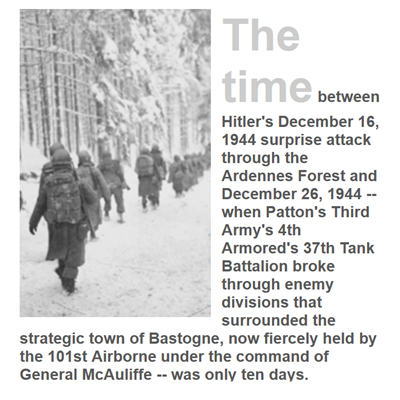
Yesterday, several months after the last entry, I opened this notebook with Marseille in my mind. I had been there as a young woman, and I wanted to write about the food, the wine, the beaches, and the unearthly blue green of the Mediterranean Sea. But what I saw in the previous entry in this notebook was soldiers in the bitter cold Ardennes.
It had not been my intention when I began writing Workshop Play Action to spend so much time on World War II battles. But the search for what happened to the fictional Ted Treharne evoked a desire for unknown information about my father, who exited from World War II as Lt Colonel Wilbur Langdon Powers. In 1944 -- while my Dad landed in Normandy and later was wounded during the Battle of the Bulge -- I was two years old, living with my mother at my grandparent's idyllic home in Cohasset, Massachusetts.
In the "dawn" section of its name was Penelope, 44 years later, I wrote:
The house was at the end of Cedar Lane,
on the edge of several acres
of cedar, oak, and birch woods
in a small seaside town
on the South Shore.
My Mother painted its name
in neat white letters.
across the toy boat's blue stern
Its name was PENELOPE
I stuck the rusty shovel into the sand
and pushed the sailboat out into the middle of the tide pool.
It was painted bright blue.
The two sails, which my mother had sewn from a torn white sheet,
filled with wind.
The boat sailed peacefully across the long finger
of trapped ocean water

I remember that the brown paper-wrapped package he sent me contained a Belgian flag, painted Belgian wooden shoes, and a miniature teddy bear, but neither why my father was overseas nor that he might never return were revealed. When he returned, like many returning fathers, he never said a word about the Battle of the Bulge.
The "dawn" section of its name was Penelope can be accessed by continually pressing "dawn" in the intial prompt, where the algorithms I wrote -- as occurs in real life -- fleetingly bring up memories and unexpectedly repeat them.
May 27, 2025
T hat the previous entry in this notebook was months ago in December of 2024 was not a surprise when I returned. It is not usual, in my case, to work on two very different creative works at the same time. But in December of 2024 -- inspired by the theme of this year's Electronic Literature Organization Conference (ELO25) -- I began working on Hunting and Gathering in Cyberspace, a work that will premiere in the exhibition "Love Letters to the Past and Future" at ELO25, from July 10-13, 2025, hosted in Canada by the University of Waterloo and York University.
That and the always interesting work by students in my School of the Art Institute of Chicago Spring "Women Artists in Cyberspace" class, meant that there was a slowdown in the writing of Workshop Play Action. Since I consider Workshop to be just that -- workshop writing for eventual print publication -- this slowdown was not problematic, but additionally, there was no time for writing in my notebook.
Importantly, I have not yet listed the books that contributed so far to the writing of the World War II theme that pervades Workshop Play Action. Thus, for this initial resumption of notebook entries, the books I read and/or am still reading are:
Stephen E. Ambrose, Band of Brothers: E Company, 506th Regiment, 101st Airborne from Normandy to Hitler's Eagle's Nest, Simon & Schuster, 2017
Joseph Balkoski, Utah Beach: The Amphibious Landing and Airborne Operations on D-Day, June 6, 1944 , Stackpole Books, 2005
Robert W. Black, Rangers in World War II, Presidio Press, 2010
Leo Barron, Patton at the Battle of the Bulge: How the General's Tanks Turned the Tide at Bastogne, Dutton Caliber, 2015
Brian Chin, Artillery at the Golden Gate: The Harbor Defenses of San Francisco in World War II, Pictorial Histories Pub Co, 1994
John S. D. Eisenhower, The Bitter Woods: The Battle of the Bulge, Da Capo, 1995
Sherri Greene Ottis, Silent Heroes: Downed Airmen and the French Underground, University Press of Kentucky, 2001
Utah Beach To Cherbourg - 6-27 June 1944, World War II 50th Anniversary Commemorative edition, Center Of Military History, United States Army, Washington, D.C., 1990. First printed by the Historical Division, War Department, for the American Forces in Action series, 1948.
From the historic images in the 1990 Edition:
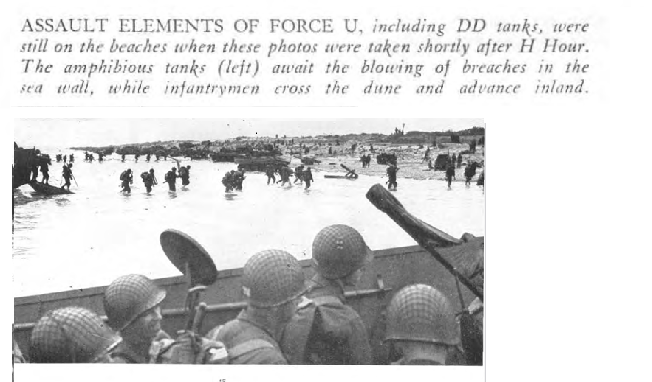
From preface information in the 1990 Edition:
"Utah Beach to Cherbourg is the work of Maj. Roland G. Ruppenthal, member of the 2d Information and Historical Service, attached to the First Army. The manuscript was edited under the supervision of Lt. Gordon Harrison of the Historical Section, European Theater of Operations, and in the Historical Division, War Department Special Staff."
Brenton Greene Wallace, Patton and His Third Army, Arcadia Press, 2019
December 21-22, 2024

Chapter two of of Workshop Play Action proceeded slowly. Nevertheless, time spent developing background narrative and introducing new characters has been productive.
I could warn of a "spoiler alert", but since this is only the second chapter, this does not seem important. These things and more have occurred:
Retired University Archivist, Kendrick MacGillivray, has identified the original occupant of the Studio /Workshop as Theodore Sinclair Treharne:
"The last time I saw him, he was in Army Uniform, complete with a Second Lieutenant s insignia. He wasn't the first or the last young man who walked out the library doors in 1942 and never returned."
A book in the studio/workshop confirms the identification:
"' .. when Ted walked into my office, on my desk was a book I had just purchased for the Library -- Exhibition of Paintings by the Late William Keith, a catalog from a 1913 exhibition at the Art Institute of Chicago. A leather-bound first edition with gold leaf printing on its spine.
"'I handed the book to Ted. 'Bring it back when you come home', I said. But he never returned.'"
The significance of the gold framed painting that hangs on the wall of the Studio Workshop is under discussion:
"Kendrick walked to the wall-hung painting, reached up, took it down. 'There are signature elements that lead me to identify this work as a mature Treharne.'"
"Nico spoke in the silence.'That beach is the beach of la Madeleine in Sainte-Marie-du-Mont. Utah Beach, about how it looked a decade or so after D-Day, when with my parents, I visited it as a child. The rough gray paint strokes are the ruins of Nazi bunkers.'
"'You will be interested to know, Jack responded 'that through undisclosed channels, my Agency has learned that in December of 1944, Captain Theodore Sinclair Treharne was listed Missing in Action during the Battle of the Bulge.'"

Meanwhile, Phoebe -- the new women's ice skating coach -- is on her way to Huygens Tech:
"It was a long way to Huygens Tech from the Calgary campus that Phoebe left when she graduated in June. It was an even longer way from her family home in Edmonton, the place where she began driving four days ago. In another day she would be in San Francisco. There, before arriving at Huygens, she would cruise the action at legendary sports bars.
"On her mind -- besides the night she had spent with a hot Park Ranger at Crater Lake National Park -- was the lunch in a cabin in the Bow River Valley, where her coach, Genevieve McGuire, had first mentioned that a college Phoebe had never heard of was looking for an interim coach to work with women ice skaters.
"...Phoebe brushed back the stray strands of the silky auburn hair that had escaped from her pony tail, straightened her short black leather skirt around her shapely long legs. That her just drafted by the Kings, boyfriend was clearly more interested in playing Hockey with Wayne Gretzky than he was in spending time with his girlfriend was becoming apparent.
"Many other men awaited on the beaches of California."
Later, in a Humboldt County stadium:
"' Humboldt Offensive Linemen appear to have grown in size since we last played them,' Durango said to Griff.
'Probably they spent August at the Humboldt equivalent of the Morton Loggers' Jubilee. When I was playing for the Huskies, every August, we would drive 80 miles or so down to Morton. There, we would bulk up on the enormous T-Bone Steaks, shrimp, beans, rice, hot jalapeno salsa, and mounds of tortillas on Loggers Plates, while we watched the inspirational Forestry School men compete in Logging Sports at the Morton Loggers Jubilee.' "Griff would have continued, but on the field, in the first play of the game, Jed Beau handed the ball to NFL prospect, Running Back Rhett Osgood-Jones..."
October 1, 2024
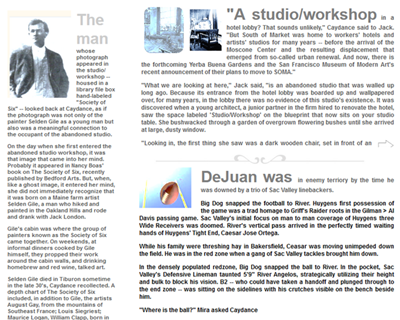
Chapter one of The Mysterious Deserted Workshop and the Secret Play-Action Pass is completed. The story is outlined in my mind; the writing will now move along a little faster. However, because Griff (football coach) and Caydance (art history professor) are immersed in the details and systems of their separate fields and because Lt Ted Sinclair Treharne's story hinges on histories of World War II military service, as is often the case, dense information distinguishes my vision and writing.
Two Notes:
1. Contemporary print fiction writers and readers are comfortable with filmic back and forth movement in narrative structures. Contingently, my vision for the series -- that began with an enigmatic work of art in book form -- was to create a work of electronic literature that readers now accustomed to ebook reading would be comfortable reading, but also to create an interface that would enable seamless transfer to a differently experienced print-based work.
In the print version, the images that focus reader attention in the eliterature version would be removed. but the text would be precisely the same. The image intertwined interface would empower interaction in which the work could be paged through via one of three tracks, moving -- at the choice of the reader -- back and forth between strings of scene-based lexias. In the print version, the reader would lose the power of interactivity but would gain the immersive sit-down-with-a-book quality, and, in this case a rhythm would underlie the whole a rhythm that might not be apparent but that would contribute to the sequential flow.
2. Lt Theodore Sinclair Treharne's narrative is fictional -- and although Ted's path diverged when he was one of the 23,000 men and women declared Missing in Action during the Battle of the Bulge -- my Father' service in the US Army during World WarII inform the "Ted" narrative in Workshop Play Action .
 Initially a 2nd Lt with the 211th Coast Artillery Regiment (Anti-Aircraft; Massachusetts National Guard), in 1941, my Father W. Langdon Powers was stationed near Palacios, Texas at Camp Hulen, the U.S. Army National Guard Anti-Aircraft training camp.
A week after Pearl Harbor his unit was transferred to California (Vallejo/Crockett). Their mission was to defend the Carquinez Strait from a potential airborne Japanese attack.
Much of the original unit was sent to the Pacific. There, most of the men from Massachusetts were killed in action. But as an instructor, my Father was sent to the Carolinas. I think to Holly Ridge, NC, home of Camp Davis, the new Anti-Aircraft training grounds. My first memory in life is riding on his shoulders on a Carolina beach.
I don't know what unit he was in when he landed in Normandy on June 7 or 8, 1944. During the Battle of the Bulge (December 16, 1944 to January 25, 1945), he was probably in General Patton s Third Army. I remember opening a brown-paper wrapped package he sent me in the Winter of 1944-1945. It contained the flag of Belgium, painted Belgium wooden shoes , and a miniature teddy bear.
There were 75, 000 American casualties in the Battle of the Bulge, where my father, eventually a Lt Colonel, was badly wounded.
September 5, 2024
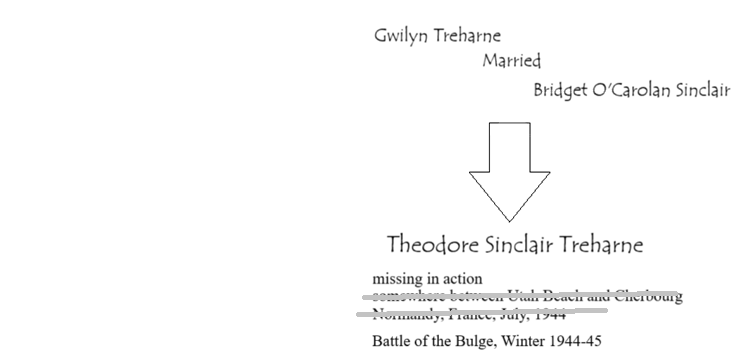
T he name of the protagonist -- formerly just known as "Ted" -- in The Mysterious Deserted Workshop and the Secret Play-Action Pass took a few months to create. This was probably a record in name difficulties in my work.
Also, in the time between my last notebook entry and Labor Day, my students in the School of the Art Institute of Chicago summer course on The Electronic Manuscript created a series of extraordinary works. I gave a talk on "Creating Electronic Literature on the Early World Wide Web" on July 20 at the 2024 Electronic Literature Conference, and I attempted (so far unsucessfully) to move home to Northern California, while at the same time work on The Mysterious Deserted Workshop and the Secret Play-Action Pass continued slowly.
California artists of the pre-World War II era appeared in recollected on this early morning, but many of the books I used for instance Nancy Boas' book on The Society of Six -- are in storage in California, although I did bring Art of the Gold Rush with me to New Jersey.
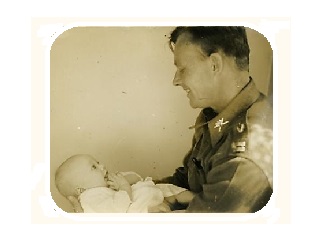 Ted's journey from the beaches of Normandy is partially inspired by my Dad (Wilbur Langdon Powers, shown in this image with me), who landed in Normandy on either Utah or Omaha beach and was wounded later probably during the Battle of the Bulge.
But, there are many details about artillary that I did not know that have required much reading. And that is only the beginning of the research that this narrative will require.
The soldiers who returned from the World War II Front did not always (if ever) tell their families what it was like. In my father's memory, the bodies in the water before he reached the beach could never be forgotten. But it was not until I was in High School that he told me this.
July 2-3, 2024
T itles for the sequel to Forward Progress on the Fields of Play have come and gone as over the last month, the plot semi-evolved. For now, the title is:
The Mysterious Deserted Workshop and the Secret Play-Action Pass.
.
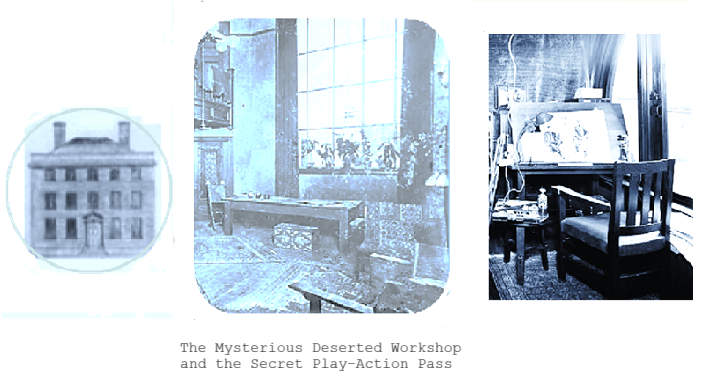
Not very succinctly, this tentative title introduces two themes in this continuation of the saga of Caydance and Griff. There are other works with "mysterious" or "abandoned "or "forsaken" workshops in their title, but the "play-action pass" is uncommon in contemporary literature titles.
In the fall of 1990, when this narrative begins, art school Adjunt Professor Caydance O Brien McGuire has been officially hired by her brother, Agent Jack O Brien, and his colleague, Agent Nico St. Denis, as the primary consultant in the case of a mysterious abandoned atelier that was revealed in the restoration of a venerable hotel South of Market in San Francisco. There is no apparent entrance to this artist's cluttered workshop from within the hotel. It appears that it was only entered through an overgrown garden in a narrow alley adjacent to the hotel.
Meanwhile, under Caydance's husband -- former Raiders Wide Receiver, Head Coach Griff McGuire -- Huygens Tech is preparing for their second D3 football season. And, Brooklyn-born Yuri, former cultural attach to US presence in Leningrad, former Enforcer for West Point Black Knights Hockey, is building a hockey presence at Huygens Tech.
It is about time to set The Mysterious Deserted Workshop and The Secret Play-Action Pass in motion. So, having finished "L0ve0ne: Creating Electronic Literature on the Early World Wide Web", my paper for this July's annual Electronic Literature Conference -- and with the syllabus for my SAIC summer class on the Electronic Manuscript finalized -- in the week before this class begins, I am designing an online interface for this work.
June 1, 2024

T oday, with the preliminary flowchart (above), I begin a writer's notebook that will document the composition of a new work that will follow Forward Progress on the Fields of Play. In my practice, a writer's notebook is needed to keep a work in progress on track, and it is necessary to start somewhere.
To begin, in the last entry of the previous notebook, I set out a brief, tentative summary of the next installment of the Caydance and Griff trilogy.
...when mysterious installation art plans are discovered in a deserted San Francisco studio South of Market, Caydance investigates; an ice rink and students with skates appear on the Huygens Tech campus; what Will did on his summer vacation is revealed; and Griff ponders unexpected issues in the Fall 1990 football depth chart...
I very much liked writing to the structure -- of a paratext followed by two lexias -- that I initiated in Forward Progress on the Fields of Play. In the online writing, this structure created a significant place for flash-backs to appear with some regularity. When the finished work was generated as a print file, it was not as noticeably apparent; nevertheless, it provided an underlying rhythm.
This structure will also shape the now tentatively and questionably titled "Paratext Installation Plans and the Run-Pass Option".
When "Paratext Installation Plans..." begins, Caydance is in an abandoned studio, where file cabinets and tables of inexplicable floor plans predominate. Because the studio is owned not rented, it was not until an architect was hired to rejuvenate the building's facade that the disappearance of the studio's owner was discovered.
Meanwhile -- with Griff's adventures in Spring football scouting in the past -- the Fall 1990 season is about to begin, and both familiar players and new players have assembled on the playing field. And, elsewhere on the Huygens Tech campus, a mobile ice rink miraculously appears.
It is my usual practice to begin writing after enough research has been done to set the stage. Then, the narrative and accompanying research evolve on the fly.